
 Deutsch
 English

We’ve already shared several posts on our blog about our students’ exciting experiences abroad. In this article, you’ll learn exactly how you can plan and make your own study abroad experience a reality—international students, in particular, should make sure to do their research beforehand. TU student Daniel from Colombia spent some time in Japan. In this interview, he talks about the challenges of studying abroad and offers tips for a successful semester in Tokyo.

Your first point of contact should be the Clausthal International Center (IZC). “If you’re interested in studying or doing an internship abroad, the best thing to do is come to our group counseling session at the IZC first,” recommends Markus Heidemann, who is responsible for the “Outgoing Mobility Worldwide” division at the IZC. “We currently offer group counseling sessions on the second Tuesday of every month in both German and English.” Here, you’ll receive an initial structured overview of various programs, funding opportunities, and ways to study abroad.
Following the group counseling session, you can schedule an individual appointment with the relevant IZC staff members. For stays abroad within Europe, Bettina Sekler (bettina.sekler@tu-clausthal.de) is your contact; for destinations outside Europe, Markus Heidemann (markus.heidemann@tu-clausthal.de) is your contact. In these personal consultations, you can discuss your plans in detail and determine the next steps together.
International Students
“Our services are open to all students at Clausthal University of Technology,” emphasizes Markus Heidemann. “However, we’ve noticed that international students in particular are showing increasing interest in spending a semester abroad.”
If you already hold a residence permit for your studies in Germany, you should definitely clarify how you can re-enter Germany without any problems after your stay abroad. Especially if you did not come to Clausthal University of Technology from another EU country, you may face additional visa or entry costs. Therefore, be sure to find out well in advance about the regulations that apply to your country of origin.
How the IZC supports you:
- Advice on selecting a suitable partner university in Europe and worldwide that is a good fit for you both academically and logistically
- Support throughout the entire application process at the partner university—from program selection and compiling application documents to meeting important deadlines
- Support in clarifying individual questions through direct contact with representatives at the partner institutions, e.g., regarding course offerings, language requirements, support structures, or special regulations for international students
- Preparation for your stay abroad, such as through foreign language courses and intercultural training at the IZC Language Center


Review by Daniel
Daniel Garcia Vasquez is originally from Colombia and studied computer science at Clausthal University of Technology. During his bachelor’s program, he wasn’t sure whether a semester abroad was even possible for international students. With the support of the IZC, Daniel took the plunge and first participated in the one-month summer school at Kanagawa University in Yokohama. He then went on to complete two exchange semesters at the Shibaura Institute of Technology (SIT) in Tokyo, a Japanese partner university of Clausthal University of Technology.
In this interview, Daniel discusses the specific challenges international students may face when planning and carrying out a study abroad experience, and how he overcame them.
What did you need to sort out before entering Japan?
Daniel: To apply for a visa at the Japanese consulate, I needed the Certificate of Eligibility. This was issued after my admission by SIT in Japan and had to be sent to me via email. However, it took a very long time for me to receive this message, which meant I ended up having to wait a long time for my visa. As a result, I was initially unable to book accommodation or buy plane tickets. Once I had the required documents, the visa application process at the consulate went relatively quickly.
How did the registration process in Japan go?
Daniel: At the beginning, international students have to register with the city administration. For this, I had to wait about three hours at the citizen’s office in my district, but then it went quite quickly and the officials spoke English quite well.
I also had to take care of the mandatory health insurance at the beginning. After registration, the insurance company sends monthly bills. I didn’t have to open a Japanese bank account because I didn’t have a part-time job. An online bank was enough for me.

What role did the visa issue play in your return to Germany?
Daniel: Since I’m Colombian and had a student visa for Germany—which allows students to leave Germany for a maximum of six months—I had to apply for a new student visa for Germany during my second semester in Japan. That turned out to be a major problem because I couldn’t get an appointment at the German Embassy in Tokyo for over two months.
When I finally got the appointment, I brought all the necessary documents with me. But the embassy staff couldn’t say whether or when I would receive the visa. That meant a lot of uncertainty and stress for me again, because I couldn’t buy plane tickets to Germany either. But I couldn’t just stay in Japan either.
Five days before my residence permit in Japan expired—about four weeks after my appointment at the German Embassy—I finally received my visa for Germany. One day before my Japanese residence permit expired, I finally flew to Germany. It was really stressful and a close call!
If I had known earlier how difficult it is to get an appointment at the German Embassy, I would have taken care of scheduling it right at the start of my second semester.

How much should you budget for?
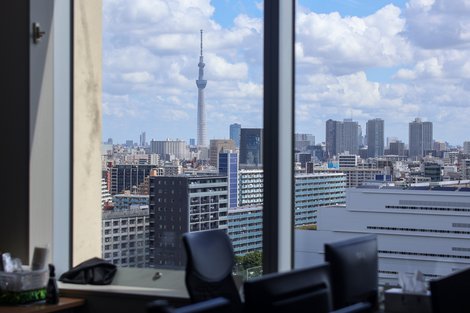
Daniel: Living in Tokyo is expensive; you should budget around 10,000 euros for the two semesters. Eating out at restaurants or buying groceries is actually almost cheaper than in Germany. But rent and transportation costs a lot of money. My apartment was very small at seven square meters and cost me 500 euros a month.
Is studying abroad recommended for (international) students?
Daniel: I’m not only taking home a deep appreciation for Japanese culture and for treating others with respect, but also many friends from Japan. During the summer school at Kanagawa University, I stayed with a host family whom I visited several times during my time in Tokyo. I definitely want to visit them again. Soon I’ll be traveling to France to visit French friends from my time at SIT.
Sure, not everything was perfect in Japan, but the time was so wonderful—I can only recommend it to everyone!

Do you have any questions, suggestions, or topic ideas for a blog post? Then send us an email: blog@tu-clausthal.de